
What is Deafblindness?
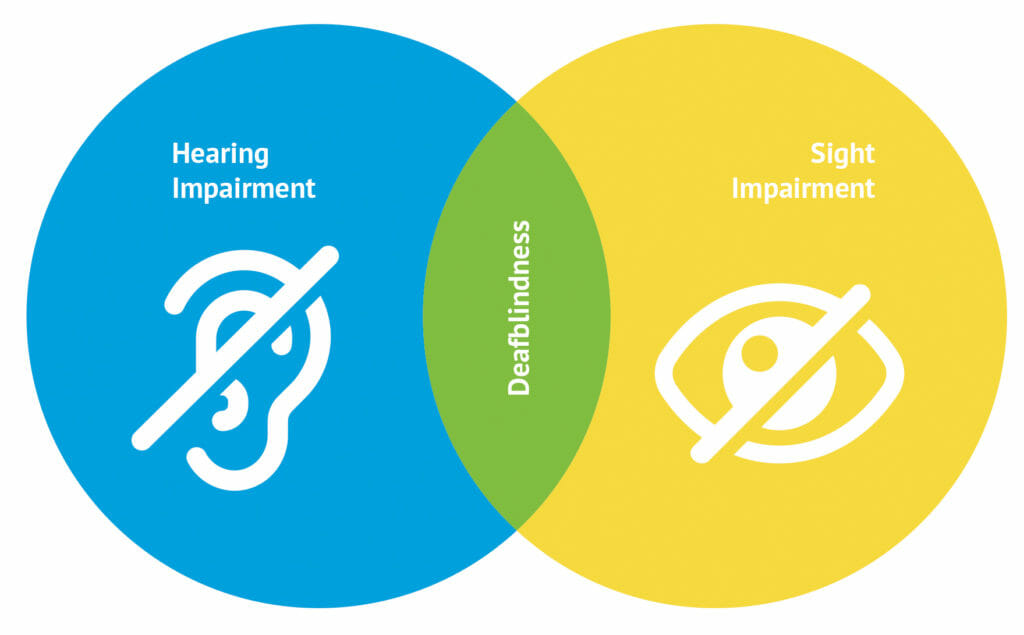
Deafblindness is a unique disability that combines varying degrees of both hearing and vision impairment. This means that deafblind people are not necessarily totally blind and deaf. Even if they have a certain degree of sight and/or hearing, they cannot use one sense to fully compensate for the impairment of the other. Thus, they need services that are different from those designed exclusively for either blind or deaf people. This dual sensory impairment affects communication, development, access to information, socialization, orientation, mobility, and daily living. However, the specific needs of each individual vary according to their age, onset, and type of deafblindness. The education of people with deafblindness requires distinct approaches and strategies to ensure these students are offered the opportunity to reach their full potential.
It is important to understand that a deafblind person experiences the world in a unique way. People who can use their vision and hearing perceive the world as far as their eyes and ears can reach, but for a person with deafblindness, the world initially extends only as far as their fingertips can reach. Their understanding of the world depends on physical contact, meaning that if no one is touching them, they consider themselves alone. In the case of people with deafblindness who have some functional vision and/or hearing, their world is automatically wider. A deafblind person may be able to use their vision to recognize familiar people, move independently in familiar environments, understand sign language at a certain distance, and read large print. Another deafblind person with valuable hearing can recognize familiar sounds, understand some speech, and develop speech themselves. It is clear that deafblindness includes a wide spectrum of sensory abilities.
0.2% of the world’s population is living with severe deafblindness and 2% with milder forms of deafblindness. This means that there are over 15 million people with severe deafblindness worldwide.
There are two main types of deafblindness: congenital and acquired deafblindness. In the case of congenital deafblindness, the baby is born with vision and hearing impairment, or it is diagnosed with deafblindness within the first two years of life (prior to the development of spoken, signed, or other visual forms of language and communication). Being born deafblind is catalytic for the development of the child, who will need to create concepts and understanding by using senses other than the distance senses that a baby with typical development would use. Acquired deafblindness is a disability that occurs later in a person’s life. Anyone can become deafblind at some point due to an illness, syndrome, accident, or age. Usher Syndrome, for example, causes deafness or hearing impairment at birth and vision impairment later in life. The development and education of a person with acquired deafblindness are expected to be significantly different from those of a person with congenital deafblindness.
There are many causes of deafblindness. Congenital deafblindness can be caused by:
- Prematurity (birth before 37 weeks of pregnancy)
- Medical complications during pregnancy and birth
- Infections during pregnancy, such as Congenital Rubella Syndrome, toxoplasmosis, or cytomegalovirus (CMV)
- Genetic conditions, such as Usher Syndrome, CHARGE Syndrome, or Down Syndrome
Cerebral palsy, which affects the brain and the nervous system and causes difficulties mainly in movement and coordination - Fetal alcohol syndrome, health problems caused by drinking alcohol during pregnancy
According to the World Health Organization (WHO), Rubella Syndrome is the leading cause of birth defects that can be prevented by vaccination.
Deafblindness can also occur later in childhood or adulthood. Acquired deafblindness can be caused by:
- Increased age
- Genetic conditions, such as Usher Syndrome, that affect hearing, vision, and balance
- Diabetic retinopathy
- Illnesses, accidents, and inherited conditions, such as meningitis, cerebral malaria, cataracts, and glaucoma
- Brain damage due to meningitis, encephalitis, a stroke, or severe head injury
It is fairly common for the same conditions that lead to deafblindness to also cause additional cognitive, physical, or other disabilities and health care needs. To fully understand a deafblind person and their needs, we need to consider the age of onset, any corrections, such as surgery or hearing aids, and the additional disabilities and health impairments. Based on the profile of the individual, professionals can interpret the behavior of the person, better understand their needs, desires, and communication, and start building a trusting relationship. Upon this relationship, they can create an educational plan that empowers the person to develop, be independent, and connect with other people and their environment.